In integrative health care, we see firsthand how much we underestimate the slow, silent ways our bodies accumulate damage over time. We talk a lot about inflammation, stress, and the wear and tear that builds up in our muscles and joints but today we want to talk about something that doesn’t always make it onto our wellness radar: sun damage.
It’s Not Just a Beach Day Problem
Most of us associate sunscreen with vacations and pool days. But the truth is, the sun is working on your skin every single day, +whether you notice it or not. Those five minutes walking to your car, your morning stroll with the dog, sitting by the window at your desk or in your car, it all adds up. Slowly. Quietly. And often without any warning signs until years later.
In integrative health, prevention is the most powerful medicine. That principle applies just as much to your skin as it does to your spine or your stress levels.
What Sun Damage Actually Does to Your Body
UV light from the sun comes in two forms: UVA and UVB rays. Think of it this way: UVA rays age your skin, penetrating deep into its layers, while UVB rays burn the outer surface and can damage your DNA. Both increase your risk of skin cancer over time.
Even if you have darker skin and rarely burn, UVA damage is still happening beneath the surface. This isn’t about skin tone; it’s about cumulative exposure over a lifetime.
Over time, sun damage can show up as:
- Fine lines, wrinkles, and loss of skin elasticity
- Sun spots and uneven pigmentation
- Broken capillaries, especially around the nose
- Red patches and rough, uneven skin texture
These changes often don’t appear until your 30s, 40s, or even later, long after the damage was done. And while some visible signs can be softened with skincare products, the deeper effects, including your cancer risk, can’t be reversed.
You May Be Getting More Exposure Than You Realize
A core principle of integrative care is awareness is being mindful of what your body is being exposed to on a daily basis. Sun exposure is no different.
Windows are a great example. Most people don’t realize that while glass blocks UVB rays, UVA rays pass right through. That means your morning routine at the kitchen table, your afternoon near the office window, and every hour behind the wheel counts as sun exposure. In fact, dermatologists often notice more aging and pigmentation on the left side of drivers’ faces, the window side, compared to the right.
It’s also worth knowing that certain medications and topical products can make your skin more sensitive to the sun. If you’re using retinols, glycolic acid, certain antibiotics, or acne treatments, read the labels carefully and take extra precautions.
Simple Steps That Make a Real Difference
Small, consistent habits are the foundation of long-term health. Here’s what we recommend when it comes to sun protection:
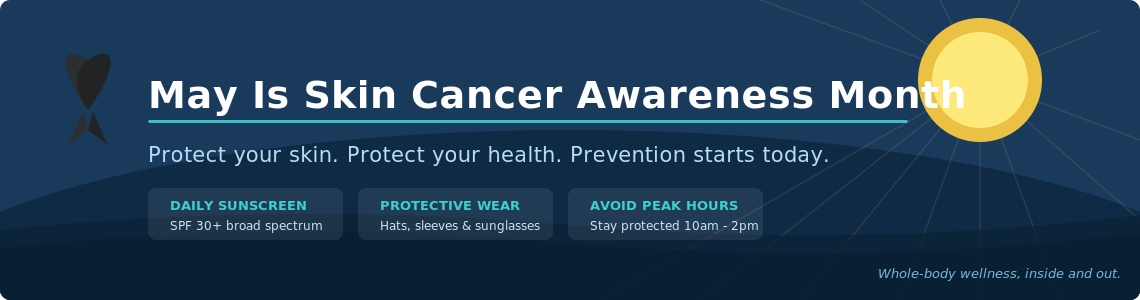
☀️ Make sunscreen part of your daily routine: Not just for beach days. Use a broad-spectrum SPF 30 or higher every morning, and reapply every two hours when spending time outside. Cover your face, neck, ears, chest, and the backs of your hands.
👒 Dress for protection: A wide-brimmed hat, sunglasses, and lightweight long sleeves go a long way, especially during outdoor activities.
⏰ Be mindful of peak hours: UV rays are strongest between 10 a.m. and 2 p.m. When possible, plan outdoor time around those windows. Check the UV index on your phone, if it’s 3 or above, your skin needs protection.
A Whole-Body Approach to Wellness
Caring for your skin is part of caring for your whole self. Whether you’re coming in for an adjustment, an acupuncture session, or a massage, the goal is always the same: to support your body’s ability to heal, function, and thrive for the long haul.
This May, add one more step to your wellness routine. Put on the sunscreen. Your future self will thank you.